Custom Cabinets vs. Stock Cabinets: Framing, Overlay, and Quality Differences
Arnie Roeland
Apr 20th, 2026
Deciding between custom and stock cabinets? Discover the critical differences in framing, door overlay, wood species, and quality to make the best choice for your kitchen remodel with Roeland Home Improvers.
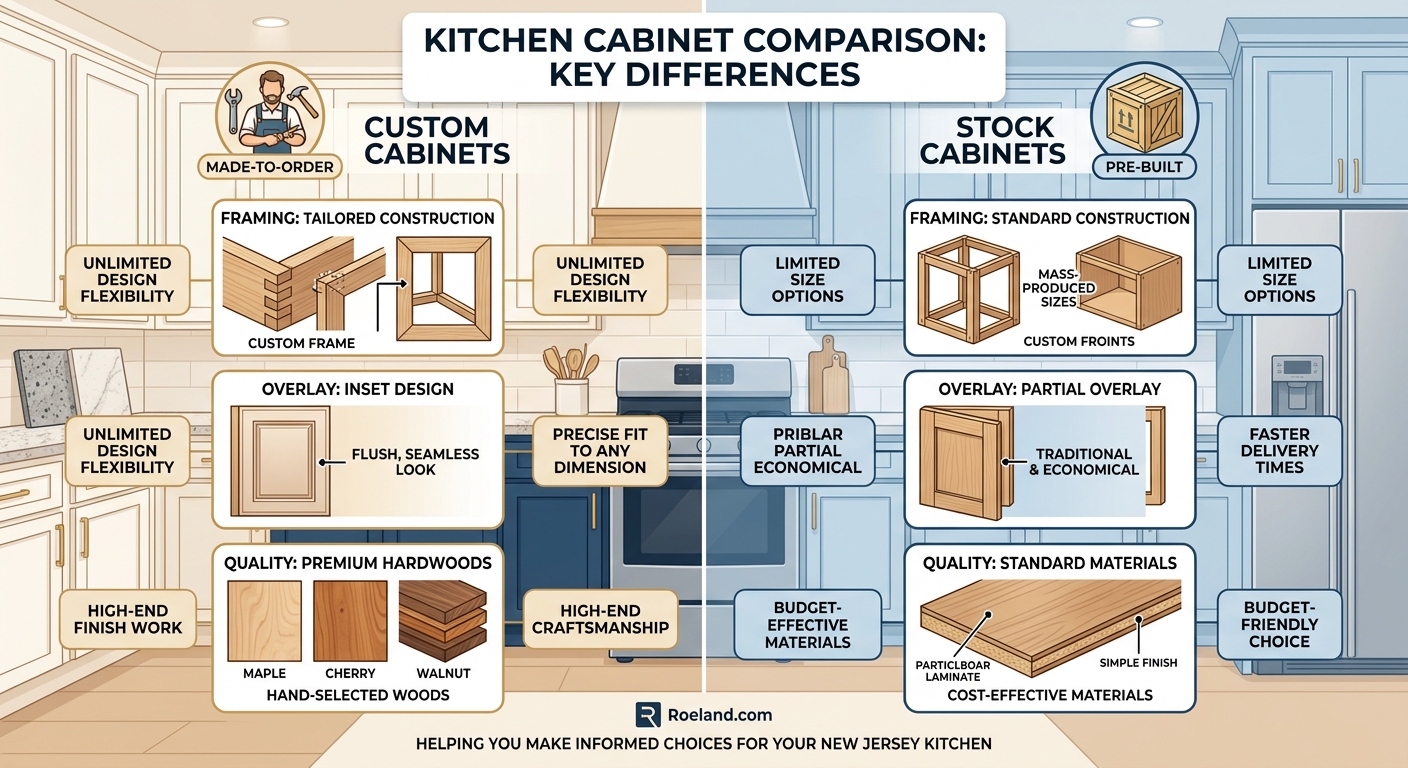
A kitchen remodel is one of the most rewarding investments you can make in your home. When planning a redesign, one decision will impact your budget, storage efficiency, and visual appeal more than any other: choosing the right kitchen cabinets.
Cabinets define the structure, workflow, and aesthetic of your kitchen. Homeowners often find themselves weighing two primary options: custom cabinets and stock cabinets. Understanding how these choices differ specifically across framing, door overlay styles, wood species, and overall construction quality is essential to making an informed decision for your project.
1. Custom Cabinets vs. Stock Cabinets: The Core Differences
Before examining technical details, it helps to understand what separates custom and stock cabinetry at a foundational level.
+------------------------+------------------------------------+------------------------------------+
| Feature                | Stock Cabinets                     | Custom Cabinets                    |
+------------------------+------------------------------------+------------------------------------+
| Manufacturing          | Pre-built in mass production sizes | Built to order for exact dimensions|
| Sizing Flexibility     | Standard increments (3-inch steps) | Fractional, tailor-made sizing     |
| Wood & Material Options| Limited stock finishes & woods     | Unlimited premium hardwoods        |
| Delivery Timeframe     | 1 to 3 weeks                       | 6 to 12+ weeks                     |
| Price Point            | Budget-friendly                    | High-end investment                |
+------------------------+------------------------------------+------------------------------------+
- Stock Cabinets: Mass-produced in standard sizes (usually in 3-inch increments starting from 9 inches up to 36 or 42 inches). They offer fast turnaround times and lower upfront costs, but limited flexibility. If your wall spans an unconventional width, filler strips are required to bridge gaps.
- Custom Cabinets: Built precisely to order to fit your kitchen's exact dimensions down to sixteenths of an inch. Custom cabinets maximize every inch of usable space, eliminate the need for filler strips, and offer unlimited choices in finishes, specialty storage inserts, and wood species.
2. Framing: Framed vs. Frameless Construction
Cabinet structure directly affects durability, interior storage capacity, and overall appearance. The two main structural designs are framed and frameless (European-style) construction.
Framed Cabinetry
Framed cabinets feature a solid wood face frame attached to the front of the cabinet box (typically built from 3/4-inch hardwood). The doors and drawers attach directly to this frame.
- Pros: Highly durable, traditional American aesthetic, reinforced structural rigidity.
- Cons: The frame slightly reduces the clear opening width of drawers and doors.
Framed vs. Frameless (European Style)
Frameless cabinetry eliminates the front face frame. Instead, thicker cabinet box walls are used, and doors attach directly to the inside walls of the box using hidden, adjustable hinges.
- Pros: Offers wider drawer space, full access to the cabinet interior, and a sleek modern visual profile.
- Cons: Requires precise installation on square walls to maintain narrow reveal gaps between doors.
3. Door Overlay Styles: Full Overlay, Partial Overlay, and Inset
The "overlay" refers to how much the cabinet door overlaps or sits inside the face frame. Overlay dictates the door profile and visual clean lines of your kitchen layout.
+------------------------+--------------------------------------------------------------------+
| Overlay Style          | Visual Appearance & Construction Details                           |
+------------------------+--------------------------------------------------------------------+
| Partial (Standard)     | 1/2" to 1" frame visible around doors; traditional look.           |
| Full Overlay           | Doors cover almost the entire frame; seamless, contemporary look.  |
| Inset                  | Doors sit flush inside the frame; premium hand crafted detail.     |
+------------------------+--------------------------------------------------------------------+
- Partial Overlay (Standard Overlay): The door covers only part of the face frame, leaving 1 to 2 inches of the frame visible around each door and drawer front. This is common in budget-conscious stock cabinet lines.
- Full Overlay: The doors and drawer fronts are oversized to cover nearly the entire face frame, leaving only a small gap (1/4 inch or less) between components. This creates a clean, continuous face suitable for both modern and transitional kitchens.
- Inset Cabinetry: A hallmark of premium custom woodworking. Inset doors sit entirely inside the face frame, resting flush with the cabinet box face. This requires precise craftsmanship, as humidity changes require tolerances so doors swing smoothly without rubbing the frame.
4. Material Quality & Wood Species Options
The materials used in cabinet construction govern how well your kitchen holds up to daily use, moisture, and wear over time.
Cabinet Box Materials
- Particleboard / Furniture Board: Common in lower-end stock cabinets. While cost-effective, particleboard is susceptible to swelling and structural weakening if exposed to water leaks under sinks.
- Plywood (Plywood Box Construction): Standard in quality semi-custom and custom cabinets. Multi-ply hardwood plywood offers high screw-holding power, superior strength, and strong resistance to moisture.
Wood Species for Doors & Faces
Selecting the right hardwood species allows you to align grain patterns, color depth, and durability with your design vision:
- Maple: A smooth, dense hardwood with subtle grain. It paints cleanly without grain show-through and takes stains evenly.
- Cherry: Renowned for its rich warmth and smooth, fine grain. Cherry naturally darkens with age and exposure to ambient light, adding richness over time.
- Oak (Red & White): Exceptionally durable with prominent grain patterns. White oak has gained immense popularity in contemporary and modern organic kitchen designs due to its neutral, cool tones and linear grain.
- Hickory: One of the hardest American hardwoods, featuring strong color contrasts from cream to dark brown. Excellent for rustic or bold statement kitchens.
- Walnut: A luxury wood species known for deep brown tones, grain variation, and rich natural character. Ideal for focal points like custom kitchen islands.
5. Completing the Look: Countertop & Cabinet Pairings
High-quality cabinetry forms the foundation, but pairing it with the right countertop surface elevates the overall design. At Roeland Home Improvers, we help guide homeowners through selecting both cabinetry structures and surface materials:
- Granite: Classic natural stone with unique pattern variations and high heat resistance.
- Quartz: Engineered stone offering low maintenance, high stain resistance, and consistent pattern control.
- Quartzite: A natural metamorphic rock providing the organic veining of marble with structural durability comparable to granite.
- Marble: Prized for elegance and veining, bringing a timeless feel to baking stations and accent islands.
Finding the Right Fit for Your Kitchen Remodel
Whether custom cabinetry or stock cabinetry fits your home depends on your layout requirements, budget, timeline, and long-term goals. Custom cabinetry provides exact fitting, inset detailing, and exotic wood selections. Quality stock or semi-custom cabinets offer durable plywood construction and faster timelines at an approachable price point.
Working with an experienced remodeling team ensures your cabinetry, layout, hardware, and countertop selections function together seamlessly.
.webp)
.svg)
.svg)
.svg)
.svg)

.svg)
.svg)

.svg)

.webp)

