The $30,000 Mistake Hiding in Your Bathroom Cabinet
I've been in the home improvement business for over 43 years. I've seen water damage that would make you sick to your stomach.But here's what keeps me up at night: most of it was completely...
I've been in the home improvement business for over 43 years. I've seen water damage that would make you sick to your stomach.
But here's what keeps me up at night: most of it was completely preventable.
Right now, over 230 million Americans face an arctic blast that meteorologists compare to hurricane-force impacts. The difference? Hurricanes give you warning. This cold front just shows up and starts breaking things.
Your pipes. Your bathroom. Your kitchen. Your budget.
The Numbers Nobody Talks About
From 2024 through June 2025, insurers paid out over $628 million on more than 20,000 frozen pipe claims nationwide.
The average claim? More than $30,000.
That's not a typo. That's enough money to completely renovate a bathroom. Instead, homeowners spend it on emergency repairs, water extraction, mold remediation, and replacing everything water touched.
Tennessee alone saw $31 million in losses from 1,100 claims in that same period. These aren't small leaks. These are catastrophic failures that destroy homes.
Your Insurance Company Has a Secret
Here's what most homeowners don't realize until it's too late: your insurance might not cover frozen pipe damage.
Insurance companies can deny claims if you didn't take "reasonable precautions." What counts as reasonable? Maintaining your home temperature at least 55°F. Properly insulating pipes. Taking basic preventive measures.
Skip these steps, and you're on the hook for the entire repair bill. About one in 60 insured homes files a water damage claim. Don't assume you're covered just because you pay premiums.
The 24-Hour Window
Water damage restoration costs homeowners an average of $3,869 in 2025. Bathroom-specific damage typically runs between $500 and $4,500. Kitchen floods? $1,000 to $5,500.
But here's the real problem: mold growth starts within 24 to 48 hours after water damage.
Mold removal costs $2,225 on average. Severe cases hit $10,000 or more. The clock starts ticking the moment a pipe bursts, and most homeowners don't move fast enough.
I've walked into homes where a small pipe burst turned into a complete bathroom gut job because the homeowner waited three days to call someone. The water damage was fixable. The mold growth made everything ten times worse.
The Danger Zone
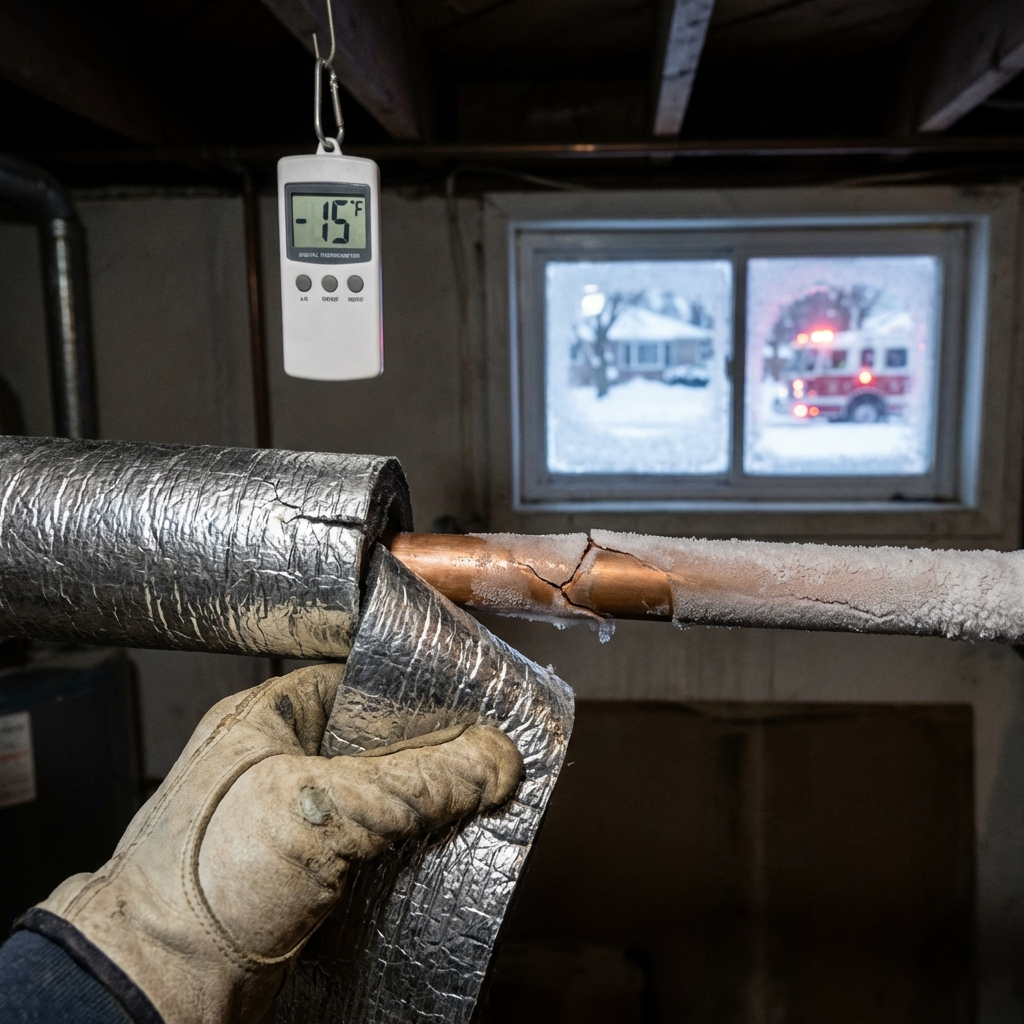
Pipes generally freeze below 20°F. But the danger zone for uninsulated pipes starts when outdoor temperatures hit 20°F or below.
Your bathroom and kitchen pipes on exterior walls? Those are the most vulnerable spots in your home.
A single burst pipe floods 250 gallons of water daily. The damage runs between $5,000 and $70,000 depending on where the pipe bursts and how long water flows before you catch it.
I've seen beautiful custom bathrooms we installed years ago get destroyed in hours because a pipe on an exterior wall froze and burst while the homeowner was at work.
What Actually Works
I'm not going to give you a complicated 47-step plan. Here's what actually prevents frozen pipes:
Open cabinet doors under sinks on exterior walls. This lets warm air circulate around your plumbing. It's the simplest thing you can do, and it works.
Let faucets drip. Not a heavy stream. Just a small drip. Moving water doesn't freeze as easily as standing water.
Maintain steady indoor temperatures. Don't drop your thermostat below 55°F, even when you're away. The money you save on heating costs disappears the moment a pipe bursts.
Insulate exposed pipes. Your crawlspace, basement, and any pipes visible in unheated areas need insulation. Heat tape works for pipes and meters in particularly vulnerable spots.
Know where your main water valve is. If a pipe bursts, you need to shut off water immediately. Most homeowners have no idea where this valve is until they're standing in two inches of water.
If You're Already in Trouble
Never use open flames to thaw frozen pipes. I've seen homeowners try blowtorches, propane heaters pointed directly at pipes, and other dangerous methods that create bigger problems.
Use a hair dryer or space heater to gently warm the area. Keep it indirect. Keep it safe.
If a pipe bursts, shut off your main water valve immediately and call a qualified plumber. Don't wait. Don't try to fix it yourself. Don't leave large flows running because you think it will help.
Utilities get overtaxed during peak cold demand. Your "solution" becomes everyone else's problem.
The Real Cost of Waiting
I've been doing this long enough to know what happens when homeowners ignore warnings.
They wait until something breaks. Then they call us in a panic. Then they find out their insurance won't cover it. Then they're looking at emergency rates, rushed timelines, and limited options because every plumber and contractor in the area is slammed.
Prevention costs almost nothing. Emergency repairs cost everything.
The homeowners who take basic precautions? They sleep fine during cold snaps. The ones who ignore warnings? They're the ones calling at 2am because water is pouring through their ceiling.
What I Tell My Own Family
I tell them the same thing I'm telling you: take this seriously before the temperature drops.
Walk through your home right now. Open those cabinet doors. Check your thermostat. Find your main water valve. Look at exposed pipes in your basement or crawlspace.
These simple steps take 15 minutes and prevent disasters that cost tens of thousands of dollars.
I've spent 43 years helping Northern New Jersey homeowners create beautiful bathrooms and kitchens. I've also spent 43 years watching preventable water damage destroy those same spaces.
You can't control the weather. But you can control whether your pipes survive it.
The choice is yours. Make it before the temperature drops.
.webp)
.svg)
.svg)
.svg)
.svg)

.svg)
.svg)

.svg)

.webp)

