The Deep Soaker Tub Is Dying (And Insurance Companies Know It)
Arnie Roeland
December 1st, 2025
I've been doing bathroom renovations in New Jersey for 43 years. I've seen trends come and go—jacuzzi tubs, corner tubs, clawfoot revivals. But here's what I'm seeing now that's different. Deep...
I've been doing bathroom renovations in New Jersey for 43 years. I've seen trends come and go—jacuzzi tubs, corner tubs, clawfoot revivals.
But here's what I'm seeing now that's different.
Deep soaker tubs are disappearing from new construction aimed at anyone over 50. Not because they're ugly. Not because tastes changed.
Because the math doesn't work anymore.
The Data Insurance Companies Are Already Using
Approximately one-third of adults aged 65 or older fall each year, and 80 percent of those falls happen in the bathroom.
That's not a design problem. That's a crisis.
Over 230,000 Americans suffer bathroom injuries annually. Among adults 85 and older, 38 percent end up hospitalized.
Falls in the bathroom are more than twice as likely to result in injury compared to falls in the living room. And two-thirds of all bathroom injuries happen in the tub or shower.
The most dangerous moment? Getting out.
Only 2% of injuries occur getting in—when surfaces are dry. The vast majority happen during or after bathing, when everything is wet and you're tired.
The Real Cost of Waiting
We do about 300 bathrooms a year. Half are tub-to-shower conversions.
The renovation runs $20,000 to $30,000.
But a hospital bill from one fall? That can be three times that amount, depending on the injury and recovery plan.
Fall-related injuries now generate over $50 billion in annual healthcare expenses. Medicare alone pays $28 billion for nonfatal falls.
Insurance companies are watching this. They're starting to connect bathroom design to claim patterns.
And here's what makes this predictable: only 55% of seniors who've already fallen have bathroom modifications.
That means nearly half the people who've experienced a fall still haven't changed their bathroom setup.
Why Soaker Tubs Are on Their Way Out
The homeowner population is aging. The average age keeps rising.
The people who still want bathtubs? Younger parents doing bath time with kids.
Everyone else is making different calculations.
I'm not saying tubs are bad. A good soak has value. But having to navigate a tub every single day is where the problem lives.
Tubs aren't easy to navigate when you're 35. They're dangerous when you're 75.
And if you're just trying to shower, they're even more slippery.
What's Coming Next
Design trends are already shifting. 66% of homeowners now address accessibility during bathroom remodels, incorporating features like curbless showers and grab bars.
Builders are responding to demographic reality. Accessibility features—wider aisles, single-level layouts, easy-reach storage—are becoming standard in homes designed for long-term living.
Within five years, I expect deep soaker tubs will be rare in new construction for buyers over 50.
Not because of regulations. Not because of mandates.
Because the industry follows the data. And the data is clear.
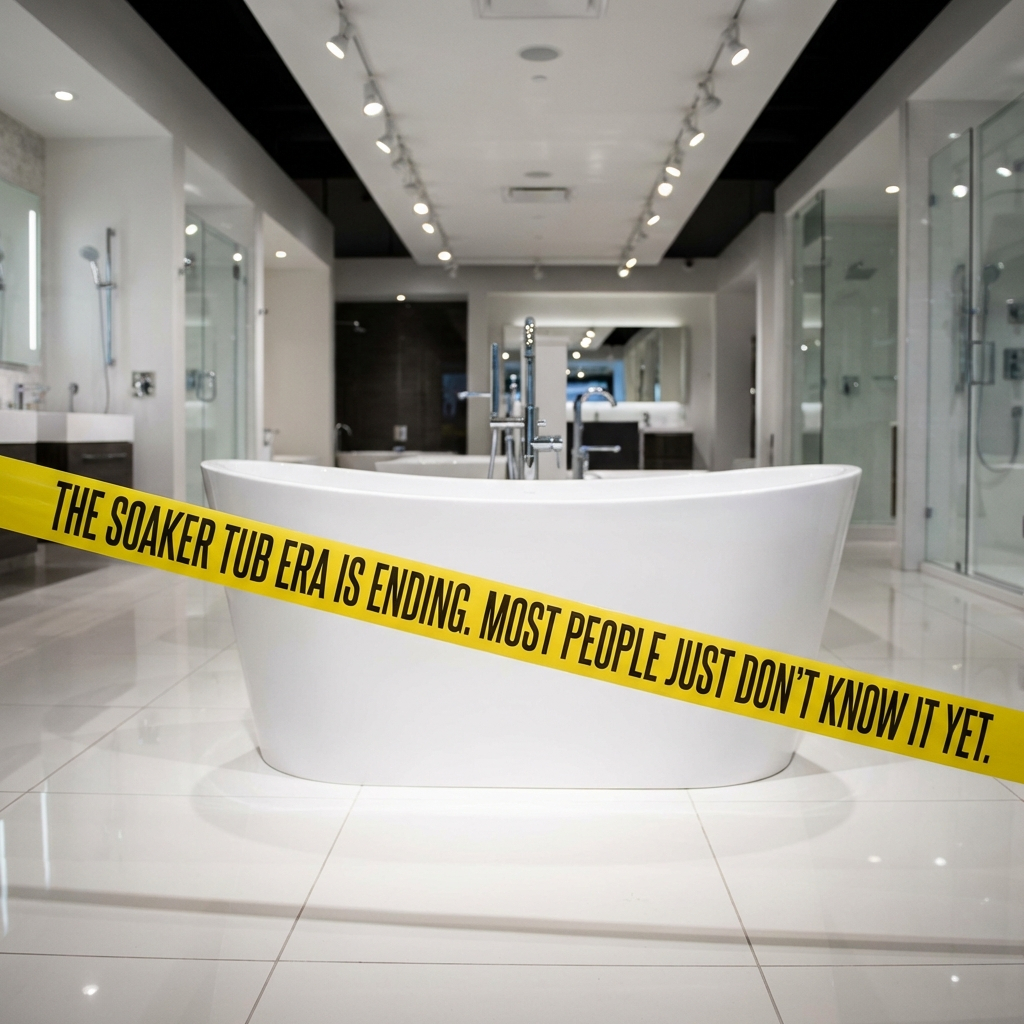
The soaker tub era is ending.
Most people just don't know it yet.
Q: Why are deep soaker tubs suddenly disappearing from homes?
A: The shift is driven by hard data and demographics, not just changing design tastes. As the homeowner population ages, people are realizing that deep soaker tubs represent a major safety hazard. Two-thirds of all bathroom injuries happen in the tub or shower, and the absolute most dangerous moment is stepping over a high tub wall when you are wet and tired. The industry is simply following the data, moving away from high-walled tubs toward safer, more accessible options.
Q: Exactly how dangerous are traditional bathrooms for older adults?
A: The statistics are alarming. Approximately one-third of adults aged 65 or older fall each year, and a staggering 80% of those falls happen in the bathroom. Falls in the bathroom are more than twice as likely to result in injury compared to a fall in the living room. For adults 85 and older who experience a bathroom injury, 38% end up hospitalized.
Q: How does the cost of a bathroom renovation compare to the cost of a slip-and-fall injury?
A: A proactive tub-to-shower conversion typically costs between $20,000 and $30,000. While that is a significant upfront investment, a single hospital bill and recovery plan resulting from a serious bathroom fall can easily be three times that amount. Nationwide, fall-related injuries generate over $50 billion in annual healthcare expenses. Investing in a safe bathroom layout upfront is a smart financial calculation that protects both your savings and your health.
Q: Are accessibility features becoming standard in modern bathroom design?
A: Yes, they are quickly becoming the baseline. Today, 66% of homeowners proactively address accessibility during their bathroom remodels. Forward-thinking designs are incorporating features like curbless walk-in showers, wider aisles, single-level layouts, easy-reach storage, and integrated grab bars. These features are no longer viewed as institutional or medical modifications; they are modern, high-end design standards meant for long-term comfort and independent living.
Q: Does Roeland Home Improvers recommend removing the only bathtub in a house?
A: It depends entirely on who lives in the home and your long-term plans. Traditional bathtubs are still highly practical for younger parents who need them for children's bath time. However, for empty nesters, seniors, or anyone planning to age in place for the next 10 to 20 years, converting an underutilized, dangerous soaker tub into a spacious, low-profile walk-in shower is almost always our recommendation. It significantly upgrades your daily quality of life while removing the highest-risk obstacle in your home.
.webp)
.svg)
.svg)
.svg)
.svg)

.svg)
.svg)

.svg)

.webp)

